How to Secure Equipment Finance in Ireland: A Guide
16 October 2026
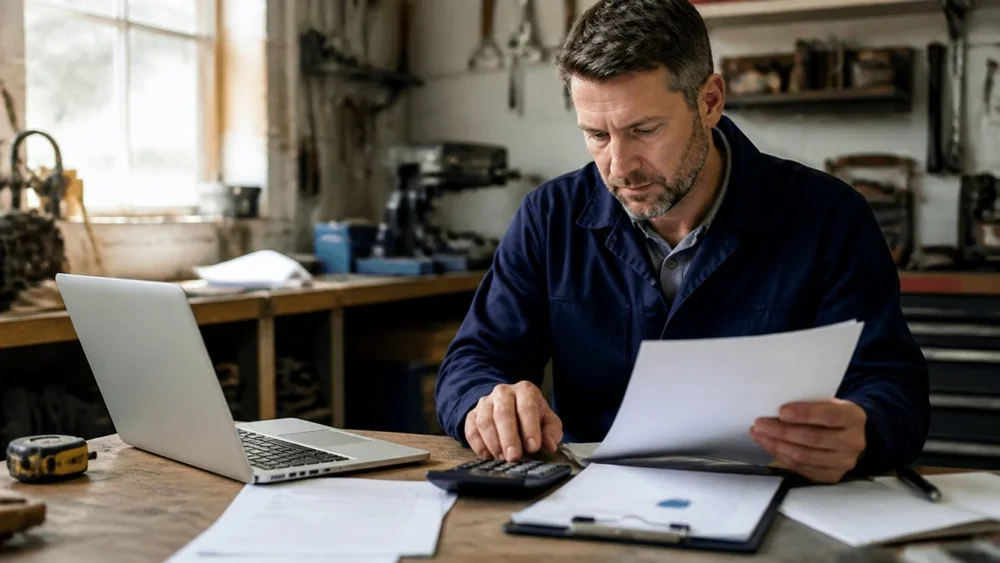
Table of Contents
How to Secure Equipment Finance in Ireland: Step-by-Step
What You'll Need Before You Apply
Types of Equipment Finance Available
Equipment Finance Application Requirements
Documents Lenders Typically Ask For
Equipment Leasing for Businesses: How It Works
Machinery Finance for Trades and Manufacturing
Equipment Finance Interest Rates and Costs
Tips to Improve Your Approval Chances
Common Mistakes to Avoid When Applying
Frequently Asked Questions
A business owner in a workshop reviewing paperwork with a laptop and calculator on a desk, focused expression, natural light from a window
What You'll Need Before You Apply
Get your paperwork ready before you approach anyone. This saves days of back and forth.
Business bank statements from the last 6 months
Recent set of accounts
A quote or invoice for the equipment
Tax clearance certificate
A short summary of what the equipment will do for your revenue
A common mistake is applying with messy or incomplete accounts. Lenders read that as risk, even when the business is healthy.
Types of Equipment Finance Available
Equipment finance is any funding arrangement that lets a business acquire machinery, vehicles, or technology without paying the full cost upfront. The main types differ in who owns the asset and how the payments work.
Hire purchase: You own the equipment once the final payment clears.
Finance lease: You use the asset and pay for most of its value, with an option to buy at the end.
Operating lease: You rent the asset for a set term and hand it back.
Asset refinance: You release cash tied up in equipment you already own.
Unsecured business loans: No asset tied to the loan, useful for smaller amounts.
Each option suits a different situation. If you plan to keep the machine for years, hire purchase usually fits best. If technology dates quickly, an operating lease lets you upgrade without being stuck with old kit.
Equipment Finance Application Requirements
Lenders assess the business, not just the equipment. They look at trading history, cash flow, and whether the repayments fit comfortably alongside your other outgoings.
Expect questions about:
How long the business has been trading
Monthly turnover and existing debt
The equipment's cost and expected lifespan
Your deposit or trade-in contribution
Some lenders want a personal guarantee from a director. This is normal for smaller firms and does not automatically mean the loan is risky.
Documents Lenders Typically Ask For
The exact list varies, but most lenders in this market ask for the same core set. Having these ready speeds up a decision.
Document Why Lenders Want It Typical Format
Bank statements Shows real cash flow 6–12 months, PDF
Financial accounts Confirms trading history Last 2–3 years
Equipment quote Sets the loan amount Supplier invoice
Tax clearance Confirms compliance Current certificate
ID and proof of address Verifies directors Photo ID, utility bill
Missing documents are the single biggest cause of delay. Send everything in one go.
Equipment Leasing for Businesses: How It Works
Equipment leasing for businesses works by separating use from ownership. You pay a monthly amount to use the asset, and at the end of the term you either return it, extend the lease, or buy it outright.
The appeal is cash flow. You avoid a large upfront payment and spread the cost across the asset's working life.
Lower initial outlay than buying outright
Predictable monthly payments
Possible tax treatment benefits, depending on your structure
Easier upgrades when technology moves fast
Leases suit equipment that loses value quickly, like computers or vehicles. For kit you'll keep for a decade, buying through hire purchase often costs less overall.
Pro Tip Check the end-of-term terms before you sign. Some leases carry balloon payments or return conditions that catch owners out. Ask what happens if you want to exit early.
Machinery Finance for Trades and Manufacturing
Machinery finance lets trades and manufacturers spread the cost of expensive kit over several years. It covers everything from excavators and CNC machines to delivery vans and production lines.
For a trade or manufacturing business, the equipment earns money. That makes the finance easier to justify. A digger that wins contracts pays for itself; a machine sitting idle does not.
Lenders look closely at:
The machine's resale value
How the equipment will generate revenue
Whether you have a contract or pipeline to support it
If you are coming from a bank loan, expect a faster process but tighter scrutiny on the asset itself. The equipment acts as security, which can mean better terms than an unsecured loan.
Equipment Finance Interest Rates and Costs
Equipment finance interest rates vary widely based on the lender, the asset, your trading history, and the term. There is no single rate, so treat any headline figure with caution.
Costs to compare beyond the rate:
Arrangement fees (BusinessLoans.ie is only paid on success by the lender. We don’t come looking for payment from you.)
Early repayment penalties
Transfer of title fee at end of finance
The cheapest rate is not always the cheapest deal. A low rate with a large balloon payment can cost more over the full term than a slightly higher rate with no final lump sum.
We recommend pricing the total cost of the agreement, not just the monthly figure. Ask each lender for the total amount payable across the term. That single number makes comparison honest.
Tips to Improve Your Approval Chances
A strong application is mostly about preparation. Lenders approve businesses that look organised and low-risk.
Keep accounts up to date and filed on time
Show a clear link between the equipment and future income
Offer a deposit if you can, even a modest one
Fix any obvious cash flow issues before applying
Apply to lenders that match your business size and sector
Watch Out Applying to many lenders at once can hurt your chances. Each application may leave a mark on your Central Credit Register file, and a cluster of them signals desperation to underwriters. Pick a few well-matched lenders instead.
At BusinessLoans, we take a single application and match it to suitable finance options.
Common Mistakes to Avoid When Applying
Most rejections trace back to a handful of avoidable errors. Fixing them before you apply saves time and improves your terms.
Applying before your accounts are ready. Messy books read as risk.
Overstating turnover. Lenders verify against bank statements.
Ignoring the total cost. A low rate can hide a large final payment.
Choosing the wrong finance type. Leasing kit you'll keep for years costs more.
Rushing the application. A day spent preparing beats a week chasing a rejected form.
The pattern is simple. Preparation wins, and haste costs money.
Frequently Asked Questions
How does equipment finance work for a business?
Equipment finance lets you spread the cost of machinery, vehicles or technology over an agreed term instead of paying the full amount upfront. You choose the equipment, the lender pays the supplier, and you repay in monthly instalments. At the end of the term you may own the asset outright or return it, depending on whether you chose a hire purchase or lease agreement. This keeps working capital free for day-to-day operations.
What documents do I need to apply for equipment finance?
Most lenders ask for proof of business identity such as a CRO number and tax reference, recent bank statements covering six to twelve months, and accounts or management figures for the last two years. You will also need a quote or invoice for the equipment itself. Some lenders request a business plan or cash flow forecast. Having these ready before you apply speeds up the process considerably and reduces the chance of back-and-forth delays.
Can a new business get equipment finance?
It is harder but not impossible. Start-ups without a trading history may need a larger deposit, a personal guarantee, or a director with relevant industry experience. Some lenders specialise in newer businesses and will look at the equipment's resale value as security. A strong business plan showing how the equipment generates revenue helps. Speaking to a broker who works with multiple lenders can surface options a single bank would not offer.
What affects the cost of equipment finance interest rates?
Several factors shape the rate you are offered: your business credit history, trading record, the size of your deposit, the type of equipment and its resale value, and the term length. Equipment that holds value well, such as construction machinery, often attracts better rates than rapidly depreciating technology. Shopping across multiple lenders through one application is the most reliable way to see what rate your business actually qualifies for.
Getting finance approved is rarely about luck. It comes down to clear paperwork, the right finance type, and applying to lenders that fit your business. BusinessLoans helps by matching your single application to suitable options, with unsecured funding up to €500,000 and same-day feedback on decisions. We also offer ongoing support through top-up facilities as your needs change. Get started with BusinessLoans and secure the funding your equipment needs.
Apply HereReady to get funded?